
August 26, 2026 · Data for Lawyers
A deposition upon written questions authenticates records under oath without a live deposition. Attorneys send written questions to a custodian, and a deposition officer records the sworn answers.
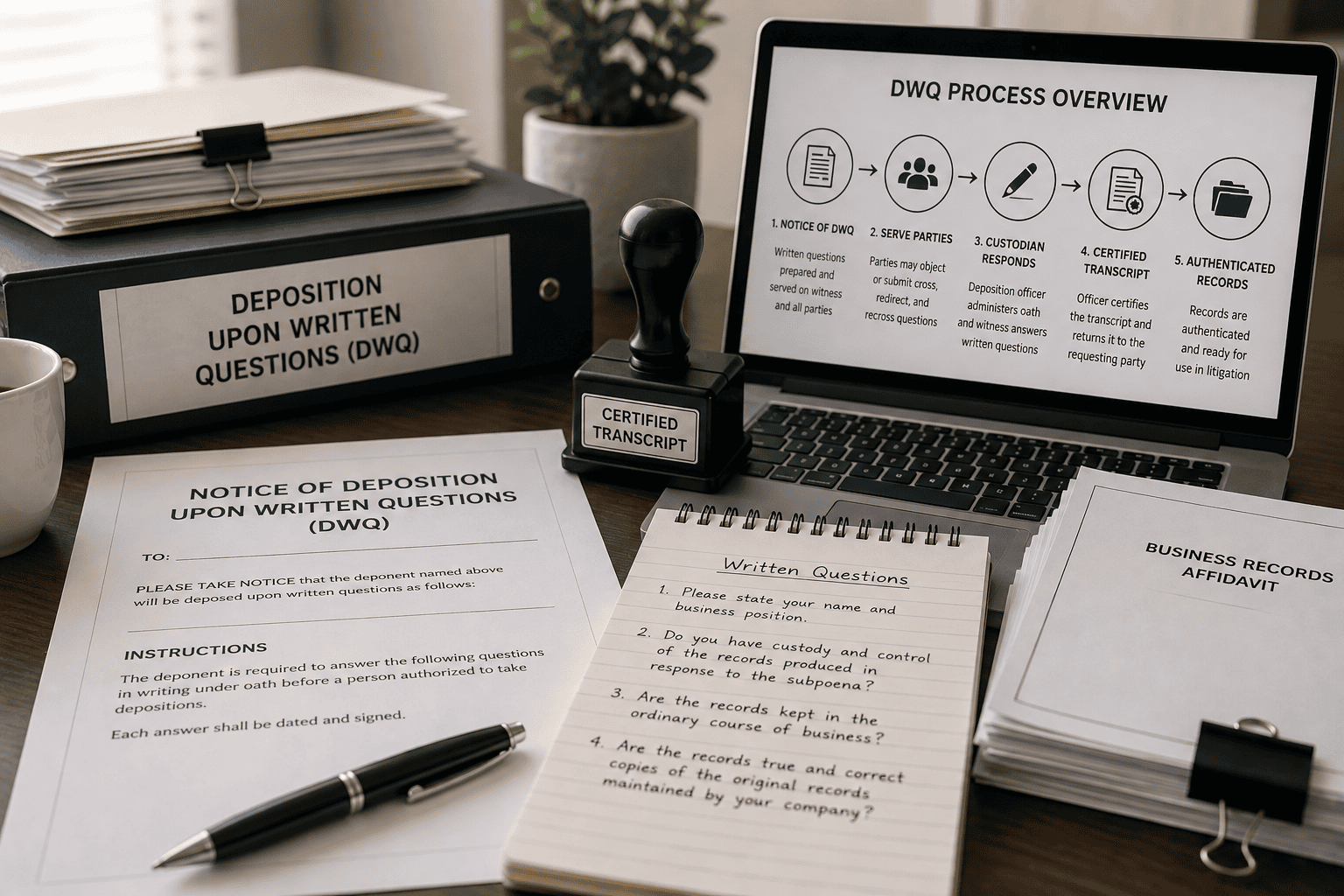
A deposition upon written questions (DWQ) is different than a typical deposition where live testimony is given under oath in a conference room. Instead of asking questions in person, attorneys prepare them in advance, and a deposition officer (usually a notary or court reporter) administers the oath, presents the questions to the witness, and prepares a certified transcript. Although DWQs can be used in many situations, they are most often associated with records requests because they provide an efficient way to authenticate documents without scheduling a traditional deposition.
For many law firms, a DWQ is less about taking testimony and more about obtaining authenticated records. Whether you need to authenticate phone records, medical records, employment files, banking statements, or other business documents, a DWQ lets a records custodian verify authenticity under oath. That process can help establish the foundation needed for admissibility while reducing the cost and time involved with a live deposition.
How a DWQ Actually Works
The requesting party prepares a notice of deposition and written questions, then serves those documents on the witness and all parties. Depending on the applicable rules, opposing parties may object or submit cross-questions, redirect questions, and recross-questions. Once those deadlines have passed, a deposition officer administers the oath, records the witness's answers, certifies the transcript, and returns it to the requesting party.
The primary limitation of a DWQ is that there is no opportunity for follow-up questions. Nobody argues over an answer in real time. Nobody follows up with, "well, what did you mean by that?" The witness answers what's on the page, and that's the record. That makes the procedure less useful for fact witnesses with extensive knowledge, but highly effective for records custodians whose testimony is limited to authenticating records or explaining routine recordkeeping practices.
That last point is the whole trade-off of a DWQ. You lose the ability to adapt, probe, or catch a witness off guard. In exchange, you get a process that's cheaper, doesn't require travel, and works well for witnesses who don't need much back and forth to begin with.
Why DWQs Are Common in Records Requests
A DWQ is commonly used when records must be authenticated before they can be introduced into evidence. Rather than scheduling an in-person deposition with a custodian who has little personal knowledge of the underlying dispute, attorneys often combine a subpoena duces tecum and a DWQ into one process. The records custodian answers a standard series of written questions and provides a custodian affidavit or business records affidavit confirming the records were maintained in the ordinary course of business.
This approach shows up across a wide range of industries: healthcare providers, financial institutions, employers, and telecommunications carriers, among others, whenever business records need a sworn foundation before trial.
Mobile Carrier Records
Mobile carrier discovery is one of the most common situations where a DWQ is valuable. A mobile carrier records subpoena may request subscriber information, call detail records, billing records, text message logs, or location information. When those records will be offered as evidence, a DWQ lets you obtain sworn testimony from the carrier's records custodian confirming the records are authentic, without pulling that custodian into a full oral deposition for information they typically don't have much more to add on.
Depositions on Written Questions Under Texas Law
In Texas, a party may take the testimony of any person or entity by deposition on written questions before someone authorized by law to take such depositions.[1] Notice of intent has to be served on the witness and all parties at least 20 days before the deposition takes place,[1] and a DWQ can only be taken outside the normal discovery period if the parties agree or the court grants leave.[1]
Getting a reluctant witness to show up isn't left to chance, either. A party can compel attendance by serving the witness with a subpoena under Rule 176, and if the witness is a party or someone under a party's control, serving the deposition notice on that party's attorney has the same legal effect as a subpoena served directly on the witness.
The question and answer sequence follows a set cadence:
- Direct questions are attached to the notice.
- Within ten days after the notice and direct questions are served, any party may object to those questions and serve cross-questions on everyone else.[2]
- Parties then have five days to object and serve redirect questions.
- Three more days remain for objections and recross-questions.[2]
It's a fast, staggered exchange, nothing like the open-ended back and forth of a live deposition.
A few quirks make DWQs distinct from Texas's other discovery tools. Even though a witness answers written questions under oath, a DWQ is not treated as "written discovery" under Texas Rule 192.7(a), so rules governing supplementation and privilege objections in written discovery don't automatically apply.[3] There's also no cap on how many questions can be asked.[3] That's a real contrast to the strict numeric limits placed on interrogatories, though Texas courts have made clear that DWQs can't be used as a workaround to exceed those interrogatory limits by another name.[3]
Because there's no opportunity for follow-up and the witness's attorney can see the questions ahead of time, DWQs tend to work best for witnesses with narrow, limited relevant knowledge (a records custodian is the textbook example) rather than for a hostile witness or a deep, complicated line of inquiry.[3]
Depositions by Written Questions Under Federal Rule 31
Federal court runs on a similar idea, with its own timeline. Under Federal Rule 31, a party generally doesn't need leave of court to take a deposition by written questions, unless the witness is confined in prison, the parties haven't stipulated otherwise, and one of a few specific conditions applies. For example, the deposition would push the total number of depositions in the case past ten, the witness has already been deposed, or the party is trying to depose someone before the discovery period officially opens under Rule 26(d).[4]
Once questions are served, other parties have 14 days to serve cross-questions, 7 days after that to serve redirect questions, and another 7 days to serve recross-questions.[5] That's noticeably longer than the Texas timeline, where the whole exchange compresses into a matter of days rather than weeks once the initial notice period passes.
Rule 31 also spells out how to depose an organization rather than an individual. A corporation, partnership, association, or government agency can be deposed by written questions the same way it would be deposed orally: by identifying the entity and letting it designate the person or people who will actually testify on its behalf.[5] This is a big part of why DWQs show up so often in records-related discovery. Instead of arguing over who at a company has to sit for a live deposition, you can send written questions and let the organization designate its own custodian to answer.
A deposition isn't considered finished until it's recorded and the witness has either waived or exercised the right to review the transcript, and the noticing party has to let everyone else know once that happens so they can make use of it.[5]
Texas vs. Federal: The Practical Differences
The two systems share the same DNA, but a few differences matter in practice:
- Notice period. Texas requires 20 days' notice before the deposition. Federal Rule 31 doesn't set a fixed notice period the same way, but the cross-question and redirect timelines run longer overall.
- Leave of court. Texas allows DWQs during the discovery window without special permission. Federal practice adds a few specific triggers, like exceeding ten depositions, that require leave even without agreement.
- Question and answer clock. Texas moves fast: 10 days for cross-questions, 5 for redirect, 3 for recross. Federal court gives parties more room: 14, 7, and 7 days, respectively.
- Treatment as written discovery. Texas explicitly excludes DWQs from its written discovery rules, which affects supplementation and privilege procedures. Practitioners should check local federal district practice on this point, since it can vary.
If you're litigating in both systems, it's worth keeping a simple checklist of these deadlines somewhere you won't lose it. They're easy to mix up, and missing a cross-question deadline can mean losing your shot at shaping the record.
Final Thought
A deposition upon written questions isn't going to replace your standard deposition practice, but it's a genuinely useful tool for the right witness, particularly when the goal is authentication rather than testimony. Understanding the mechanics, whether in Texas, in federal court, or both, means you'll know when to reach for it instead of scheduling a live deposition you don't actually need.
Managing Multiple Records Requests
Preparing one DWQ is straightforward. Managing dozens across hospitals, employers, mobile carriers, and other third-party providers can quickly become an administrative challenge. Deadlines, subpoenas, transcripts, affidavits, and authenticated records all need to stay organized throughout the litigation process.
Data for Lawyers helps litigation teams organize DWQs, records requests, subpoenas, and supporting documentation in one centralized workflow, reducing administrative work while helping firms stay organized.
Need Help Managing DWQs and Records Requests?
Whether you're authenticating phone records, medical files, or other business documents, staying organized matters just as much as understanding the rules.
Data for Lawyers provides a centralized platform for managing records requests, subpoenas, DWQs, and supporting documentation from start to finish.
Have questions or want to see how it works? Contact our team today.
References
- Rule 200.1, Procedure for Noticing Deposition Upon Written Questions, Texas Rules of Civil Procedure
- Rule 200, Depositions Upon Written Questions, Texas Rules of Civil Procedure
- Chapter 11, 11-3 Depositions on Written Questions, Texas Rule 200
- Rule 31, Depositions by Written Questions, Federal Rules of Civil Procedure
- Federal Rules of Civil Procedure, Rule 31, Depositions Upon Written Questions